

Someone plays a single note on a piano in another room, and a musician calls out “that’s an F sharp” without missing a beat. No reference note, no second-guessing — just an instant, confident answer. It looks like a magic trick. It’s actually a rare ability called perfect pitch.
So what is perfect pitch, really? It’s the ability to identify or sing any musical note by name with no reference tone to compare it to. For people who have it, naming a pitch feels as effortless and obvious as naming a color — you just know a fire engine is red, and they just know that note is a G.
It’s one of the most misunderstood abilities in all of music. People assume it means you’re a musical genius, that you’re born with it or you’re not, and that there’s no point trying to learn it as an adult. As it turns out, almost all of that conventional wisdom is at least partly wrong.
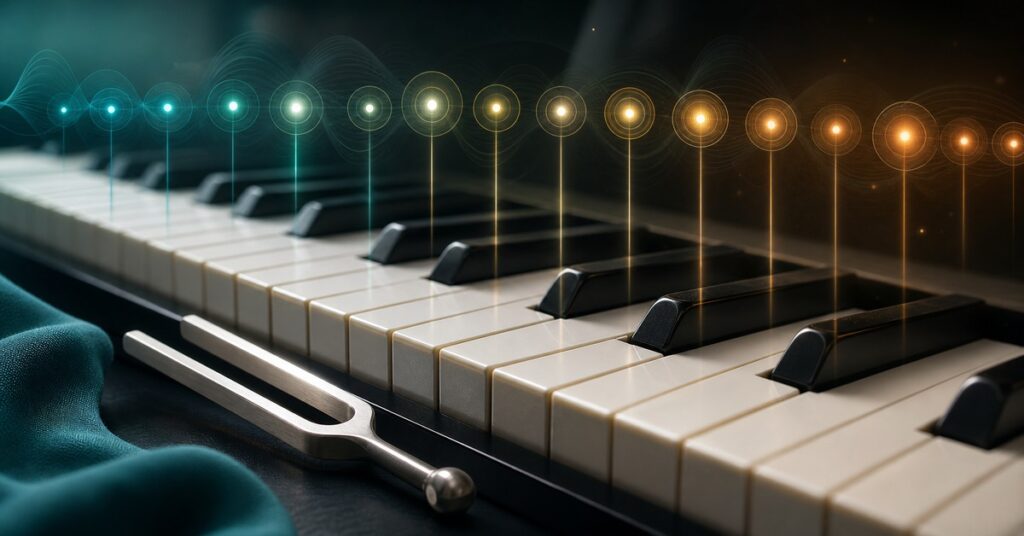
Let’s bust the myths, look at what science actually says, and answer the big question: can you really learn perfect pitch?
What Is Perfect Pitch, Exactly?
Perfect pitch — known to scientists as absolute pitch — is the ability to name or reproduce any given musical note without a reference. Play a note and a person with absolute pitch can tell you it’s a C; ask them to sing a B flat out of thin air and they can do it.
Identification is near-instant and effortless for those who have it. Researchers often compare it to color perception: you don’t calculate that the sky is blue, you simply perceive it. People with absolute pitch perceive notes the same automatic way.
Perfect pitch isn’t about hearing better — it’s about having a permanent mental label attached to every pitch.
Perfect Pitch vs. Relative Pitch: What’s the Difference?
This is the single most important distinction in the whole conversation, and it’s where most confusion lives.
Relative pitch is the ability to identify notes in relation to one another. Give someone with relative pitch a starting note and they can work out every other note from there by hearing the distance — the interval — between them. This is how most trained musicians operate, and it’s a genuinely powerful skill.
Absolute (perfect) pitch needs no starting reference at all. The note is identified on its own, in isolation.
Here’s the part that surprises people: for almost everything musicians actually do — playing in a band, harmonizing, transposing, improvising, sight-reading — relative pitch is the more useful skill of the two. And unlike perfect pitch, relative pitch can be reliably trained by anyone at any age.
How Rare Is Perfect Pitch?
Truly rare — though exactly how rare is genuinely hard to pin down. The most commonly cited figure is that fewer than 1 in 10,000 people in the general Western population have full absolute pitch, but that number is widely repeated and not especially well-evidenced. Estimates vary a lot, and among trained music students the rate runs to several percent or more.
What’s clear is that it climbs steeply among trained musicians, and climbs higher still in certain populations we’ll get to in a moment. But in the population at large, it’s genuinely uncommon — which is exactly why it carries such a mystique.
Perfect pitch is rare, but as we’ll see, rarity doesn’t mean it’s purely a gift of the gods.
Which Famous Musicians Have Perfect Pitch?
The list of confirmed and reputed possessors reads like a hall of fame. Wolfgang Amadeus Mozart is the classic historical example, said to have identified and reproduced pitches with uncanny accuracy as a young child.
In more modern music, names frequently cited include Ella Fitzgerald, Freddie Mercury, Mariah Carey, and Jimi Hendrix, among many others. Worth a caveat, though: most of these modern cases are anecdotal rather than formally tested, and some often-cited “evidence” (like tuning by ear) actually shows excellent relative pitch rather than true absolute pitch.
But here’s the myth-buster: **plenty of the greatest musicians in history did not have perfect pitch** — and it didn’t hold them back one bit. Many legendary performers and composers relied on superb relative pitch instead. Perfect pitch is a fascinating trait, not a requirement for genius.
Is Perfect Pitch Genetic or Learned?
For a long time the debate was framed as nature versus nurture. The modern answer is: it’s almost certainly both, working together.
There’s clear evidence of a genetic component. Absolute pitch runs in families, and genome studies have linked it to specific regions of the DNA. Some people appear to inherit a predisposition for it.
But genes alone aren’t enough. Many people with the supposed predisposition never develop perfect pitch — and crucially, early musical training appears to be necessary to switch the ability on. The leading view is that perfect pitch emerges from a confluence of inherited potential and the right experience at the right time.
The “Critical Period”: Why Childhood Matters So Much
The right time, traditionally, means very young. Researchers have long pointed to a critical period — roughly the preschool years, often cited around ages 5 to 6 — during which the developing brain can lock pitches to names.
The theory goes that young children naturally perceive sound in an “absolute” way. As we grow, our brains shift toward processing sound relatively — focusing on the relationships between notes, which is more useful for language and melody. That shift is thought to make absolute pitch much harder to acquire later on.
This is why nearly everyone with strong perfect pitch started serious musical training as a small child. The window for picking it up effortlessly seems to open early and close fast.
Why Do Speakers of Tonal Languages Have More Perfect Pitch?
One of the most striking clues comes from language. In tonal languages like Mandarin, Cantonese, and Vietnamese, the pitch you say a word at changes its meaning entirely — the same syllable spoken at different pitches becomes different words.
Speakers of these languages learn from infancy to lock pitch to meaning, and the effect on absolute pitch is dramatic. Research by psychologist Diana Deutsch found that Mandarin-speaking music students were far more likely to have perfect pitch than English-speaking students with comparable training — in one well-known study, the gap was enormous.
This is powerful evidence for the nurture side of the equation. If early exposure to meaningful pitch can build absolute pitch into ordinary speakers, then experience clearly plays a huge role — not just genes.
Can Adults Actually Learn Perfect Pitch?
This is the question everyone really wants answered, and the honest reply has shifted in recent years. The old view was a flat “no — miss the critical period and the door is closed forever.”
Newer research has cracked that door back open. Studies, including work from the University of Chicago, have shown that adults can make real, measurable improvements in identifying notes by ear. In one training program, a group of adult musicians practiced over several weeks, and the strongest learners reached impressively accurate, near-perfect-pitch levels of recognition — identifying pitches quickly and reliably, with the very best retaining the skill months later.
The catch is that this learned ability tends to be more effortful and less rock-solid than the lifelong version, and it can fade without practice. So the realistic verdict: you probably can’t gain flawless, automatic perfect pitch as an adult, but you can absolutely train yourself to identify notes far better than you’d think — for many people, good enough to feel like the real thing.
What About the “Perfect Pitch Pill”?
You may have seen headlines about a drug that unlocks perfect pitch. There’s a real study behind them, and it’s genuinely fascinating — but widely overhyped.
Researchers found that a drug called valproate (a mood stabilizer that affects brain plasticity) helped adult men learn pitch identification better than a placebo, seemingly by reopening some of that childhood “critical period” flexibility.
It was a small, preliminary experiment, not a magic pill, and valproate is a serious medication with real side effects — not something to take to learn music. The takeaway isn’t “pop a pill for perfect pitch” — it’s that the adult brain may be more re-openable to this kind of learning than we once believed.
How Do You Train Your Ear If You Want To Try?
Whether or not you ever reach true absolute pitch, ear training pays off enormously for any musician. If you want to chase note recognition, here’s a sensible path:
- Start with relative pitch. Learn to recognize intervals and chords. It’s more achievable, more useful, and builds the foundation for everything else.
- Anchor to a reference note. Memorize the exact pitch of one familiar sound — many people use a song they know cold, or a single tuning-fork note — and learn to find other notes from it.
- Practice pitch-class recognition rather than fussing over exact octaves. Naming the note family (all the C’s, all the G’s) is the part trainable adults improve most.
- Use a single, consistent instrument timbre when you start; pitch is easier to learn on a familiar sound before generalizing.
- Practice little and often. Short daily sessions beat rare marathon ones, and consistency is what makes recognition stick.
The goal for most people shouldn’t be “perfect pitch or bust” — it should be a sharper, more confident ear, which is genuinely within everyone’s reach.
Perfect Pitch Frequently Asked Questions
Is perfect pitch better than relative pitch? Not for most musical purposes. Relative pitch is more practical for playing, singing, and transposing — and it’s trainable by anyone.
Can perfect pitch be a downside? Sometimes. Some people with absolute pitch find it jarring when music is played in a different key or slightly out of tune, and transposing on the fly can feel uncomfortable.
Do you have to be a great musician to have perfect pitch? No. Perfect pitch and musical skill are related but separate. Many brilliant musicians lack it, and having it doesn’t automatically make you a great player.
Does perfect pitch fade with age? It can drift slightly. Some older possessors report hearing notes as a touch sharp, a known effect tied to age-related changes in hearing.
Final Thoughts
So, what is perfect pitch? It’s the rare and remarkable ability to name any note on the spot — a blend of inherited predisposition and early experience, most reliably wired in during a critical window of childhood, and dramatically boosted by things like growing up speaking a tonal language.
But the myths around it deserve to fall. It isn’t a marker of genius, it isn’t strictly all-or-nothing, and it isn’t completely off-limits to adults. Relative pitch is the more useful skill for nearly everything you’ll do as a musician — and that one, anyone can build.
If you’ve ever felt that perfect pitch was a club you were locked out of at birth, take heart: the ear is far more trainable than the legends suggest. Pick a reference note, practice a few minutes a day, and start listening more closely. You might be amazed how far that takes you.