

You’re in the car, a song you haven’t heard in years comes on, and out of nowhere your throat tightens and your eyes sting. Nobody died. Nothing’s wrong. It’s just music — and yet here you are, blinking back tears at a red light.
If that’s ever happened to you, you’ve probably wondered why does music make you cry in the first place. It’s one of the strangest, most human things we do: a pattern of sound waves with no words of comfort and no actual bad news can reach straight past your defenses and open the floodgates.
The good news is that there’s real science here, and it’s genuinely lovely once you understand it. Crying at music isn’t a sign that you’re fragile or too sensitive. It’s a sign that your brain’s reward system, your memory, and your capacity for empathy are all working beautifully — often all at once.
Let’s walk through what’s actually happening when a song moves you to tears, why sad music can feel so good, and why some of us cry more easily than others.

Is It Normal To Cry At Music?
First, the reassurance: yes, it’s completely normal, and you’re in very good company.
Being moved to tears by music is one of the most common emotional experiences people report. In one large international survey of more than 700 listeners, a majority said they enjoy sad music and turn to it when they’re in a low mood, rather than avoiding it.
People who cry at music tend to score high on empathy and on something psychologists call “absorption” — the ability to get fully swept up in an experience. In other words, the tears aren’t a malfunction. They’re the by-product of a brain that feels things richly and connects deeply.
So if you’ve ever felt a little embarrassed about welling up during a film score or a quiet ballad, let it go. Your nervous system is doing exactly what an emotionally healthy one does.
Why Does Music Make You Cry? What Happens In Your Brain
Here’s where it gets fascinating. When a piece of music really lands, it lights up the same reward circuitry in your brain that responds to food, and other primal pleasures.
The landmark study here came from researchers at McGill University in 2011, who scanned people’s brains while they listened to music that gave them intense emotional peaks. They found that music triggers the release of dopamine — the brain’s “this feels good, do it again” chemical — in the striatum, the reward center deep in the brain.
Music, it turned out, is a genuine reward to the brain — not a metaphorical one. It engages the same machinery as our most basic pleasures.
But the really clever part was the timing, and it explains a lot about that lump-in-the-throat moment.
Why Does The Build-Up In A Song Hit So Hard?
The McGill team discovered that dopamine gets released in two separate waves, in two different parts of the brain.
First, in the anticipation of a big musical moment — the swell before the chorus, the held breath before the key change — dopamine fires in a region called the caudate nucleus. Then, at the emotional peak itself, a second hit of dopamine floods a region called the nucleus accumbens.
That two-stage design is why the build matters so much. Your brain is essentially rewarding you for predicting where the music is going — and then rewarding you again when it delivers. The tension and release of a great song is a chemical event, not just a poetic one.
There’s one more twist. When we listen to music we find pleasurable, activity in the amygdala — the brain’s threat-and-alarm center — actually tends to quiet down as the emotion builds. The music floods you with reward while turning down the alarm bells, which is part of why being moved to tears by a song you love feels safe and even comforting rather than upsetting.
Why Do Sad Songs Feel So Good? The Music Paradox
Here’s the puzzle that’s kept researchers busy for years: if sadness is unpleasant, why on earth do we choose music that makes us sad? Why do we put on the heartbreak playlist on purpose?
This is known as the paradox of music-evoked sadness, and the answer is surprisingly tender.
When researchers asked hundreds of people what emotions sad music actually stirs in them, the number-one answer wasn’t sadness at all. It was nostalgia, named by about 76% of people. Sadness came in well behind. People also reported strong feelings of peacefulness, tenderness, and wonder.
In other words, “sad” music rarely makes us purely sad. It makes us feel a rich, bittersweet blend — and tears are how that fullness spills over.
That bittersweet feeling also shows up across whole genres. If you want a broader musical example, our guide to the history of the blues shows how sorrow, resilience, and beauty can live inside the same sound.
Crucially, the sadness in music is felt safely. There’s no real loss, no real threat — just the shape of the emotion, experienced inside the protected container of a song. Music lets you feel the depth of sorrow without paying its price. That’s why a good cry to music so often leaves you feeling lighter, not worse.
What’s The Difference Between Crying And Getting Chills?
You might notice that some music gives you goosebumps and a shiver down the spine, while other music brings tears. They’re cousins, but not quite the same thing.
Chills — sometimes called frisson — lean toward awe, thrill, and that electric peak-pleasure rush. Tears lean toward tenderness, nostalgia, and the feeling of being deeply moved. The same song can deliver both, but they ride slightly different emotional currents.
If the shiver-down-the-spine sensation is what fascinates you most, it has its own rich science worth exploring in our piece on why music gives you chills. For now, just know that tears tend to show up when a song touches something tender and personal rather than simply something thrilling.
The Chemicals Of Comfort: Prolactin, Oxytocin And More
Beyond dopamine, scientists think a handful of other brain chemicals play a part in musical tears — though this is where we have to be honest about the limits of the science.
One leading idea, proposed by music psychologist David Huron, is that sad music may trigger prolactin — a hormone your body also releases during genuine crying, and one associated with comfort and consolation. The theory is that prolactin is the brain’s way of soothing you after sorrow, and that music sets off that soothing without any real grief behind it.
It’s an appealing idea, and it might be part of the picture. But it’s a hypothesis, not a proven fact — there’s no direct experimental confirmation, and the theory has been seriously challenged, including by Huron himself in later work. So treat it as a promising lead rather than settled truth.
Oxytocin, the “bonding” hormone, and the body’s natural endorphins are also commonly linked to music’s emotional power. The honest summary is that several feel-good and feel-soothed chemicals are probably involved, and researchers are still mapping exactly how.
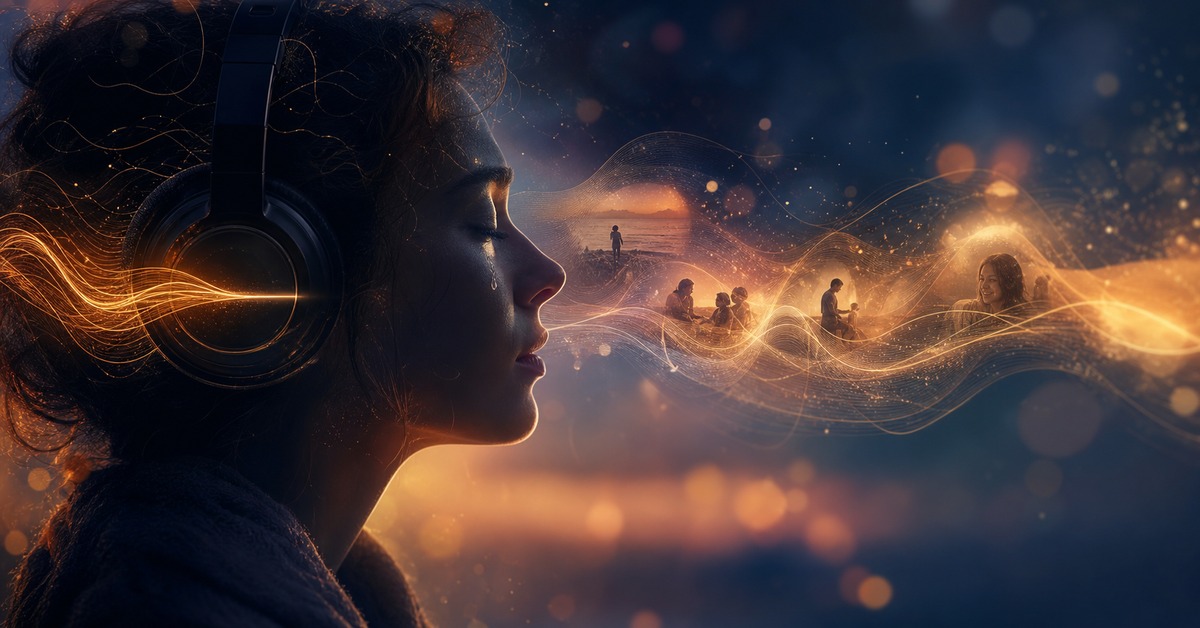
How Does Memory Make Music So Emotional?
Sometimes a song moves you not because of the notes, but because of when you last heard them.
Music is bound unusually tightly to autobiographical memory. A particular song can be welded to a person, a summer, a relationship, or a version of yourself you’ve left behind. When the song plays, the memory comes with it — and so does the feeling attached to it. In the music-and-sadness research, memory was rated the single most important pathway through which music evokes emotion.
There’s even a known pattern called the “reminiscence bump.” The music we encounter roughly between the ages of 10 and 30 tends to carry the heaviest emotional charge for the rest of our lives. That’s why the songs of your teens and twenties can floor you decades later while newer hits leave you unmoved.
Memory is only one part of the story, though. The same pattern-loving brain that stores emotional songs so deeply is also why songs get stuck in your head and why rare skills like perfect pitch feel so fascinating.
Often the tears aren’t about the music at all — they’re about everything the music is carrying.
Why Do Certain Notes Trigger Tears?
Beyond memory and chemistry, the music itself has tricks that reliably tug at us — and some of them can be pinpointed in the score.
Psychologist John Sloboda once asked people to identify the exact passages in music that gave them a lump in the throat, then studied what those moments had in common. A striking pattern emerged: most of them contained a little ornament called an appoggiatura — a note that clashes slightly with the melody before resolving back into it.
That tiny clash creates tension; the resolution releases it. Stack several of these together and you get a rolling cycle of tension and relief that can tip a listener over into tears. Adele’s Someone Like You is famously sprinkled with these ornamental notes, which is a big part of why it reliably wrecks people.
Other reliable tear-triggers include a sudden key change, a lone voice emerging out of silence, a slow swell in volume, an unexpected harmony, and a lyric that lands at exactly the right moment. Great songwriters know these levers — and they pull them on purpose.
Why Do Some People Cry More Easily Than Others?
If your friend sobs at every film score while you stay dry-eyed, neither of you is broken. People simply vary.
A few things shape how easily music moves you to tears. Trait empathy is a big one — people who feel others’ emotions strongly tend to feel music’s emotions strongly too. So is absorption, that capacity to get fully lost in an experience. Musical training and the sheer amount you engage with music matter as well; the more deeply you listen, the more there is to be moved by.
Your mood in the moment counts too. The same song can slide right past you on a good day and undo you on a hard one.
And if you rarely cry at music? That’s perfectly fine. Not crying doesn’t mean not feeling — plenty of people experience music intensely without the tears ever reaching their eyes.
Is Crying To Music Actually Good For You?
For many people, a good cry to music feels less like falling apart and more like a release — and there’s something to that.
Because musical sadness is felt safely, with the brain’s alarm system turned down and its reward system turned up, it can act as a kind of gentle emotional workout. People often describe crying to music as cathartic: a way to process feelings, sit with a memory, or simply let something out that’s been building up.
Music has long been studied for its broader effects on mood and wellbeing, a topic we dig into in how music affects your brain. A tearful song, used the way you’d use a long walk or a good talk, can genuinely help you reset.
So the next time a track catches you off guard at a red light, you don’t need to fight it. Let the song do its work.
Final Thoughts
So, why does music make you cry? Because a great song presses several of your most human buttons at the same time. It floods your brain’s reward system with dopamine in a perfectly timed two-stage rush, quiets your inner alarm so the feeling lands as safe rather than threatening, drags up memories welded to the melody, and triggers empathy for the emotion in a singer’s voice — all while a few well-placed notes ratchet tension and release until something gives.
Far from being a weakness, those tears are a sign of a brain that’s deeply, wonderfully wired for music. The same sensitivity that makes a song undo you is the sensitivity that lets music thrill you, comfort you, and stay with you for a lifetime.
So put on the song that gets you every time. Let it move you. That lump in your throat is your brain telling you the music is working exactly as it should.